


Heritage Highlight: At the Toronto Caribbean, we believe in honoring our narrative. This article is a ‘gem’ from our earlier coverage that offers a unique perspective on Kwanzaa proof that the truth never goes out of style.
Back in high school during the ’90s, I thought Kwanzaa was just something cool that Black people made up—and honestly, it is something extraordinary that Black people came up with. My teenage understanding stopped at the beautiful kente cloth displays and African pendants I coveted at the mall. What I didn’t understand then—what school never taught me—was that Kwanzaa isn’t just a “Black Christmas” alternative. It’s a healing practice disguised as a holiday, and our Caribbean community in Toronto needs it now more than ever.
Dr. Maulana Karenga created Kwanzaa in 1966 after the Watts riots, seeking ways to bring African Americans together as a community. Think about that timing: in the aftermath of violence and division, he designed a framework for healing. The seven principles, the Nguzo Saba, are a prescription for everything that’s broken in our communities.
Let’s break down these principles, because each one speaks directly to what we’re struggling with as Caribbean people in the diaspora:
- Umoja (Unity)calls us home to each other in a city where Caribbean families are scattered across the GTA.
- Kujichagulia (Self-Determination) reclaims our power to define and name ourselves rather than letting others tell our stories.
- Ujima (Collective Work and Responsibility) means your struggle is my struggle; your success is my success.
- Ujamaa (Cooperative Economics) validates what we already know works—think of every Caribbean business on Eglinton West.
- Nia (Purpose)focuses our collective vocation on building community and restoring our people to greatness.
- Kuumba (Creativity)shows up in every steelpan orchestra and jerk chicken festival.
- Imani (Faith)means believing in our people beyond religion, a deep trust in each other.
These principles mirror Ubuntu, the African philosophy that says, “I am because we are.” Kwanzaa provides a structured way to practice Ubuntu each year, intentionally focusing on values that heal collective trauma.

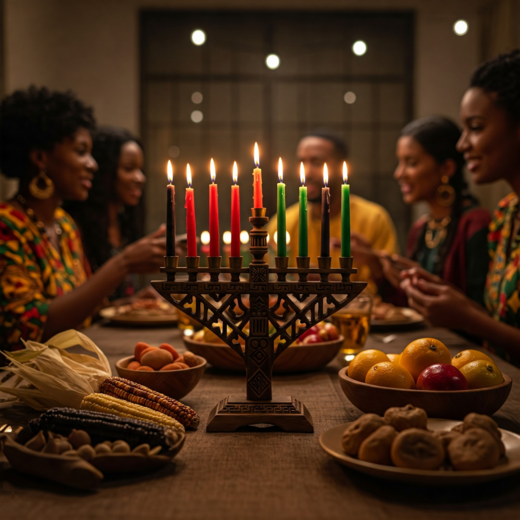
Here’s how your family can start this year: You don’t need expensive artifacts. Create a simple kinara from materials you have on hand. Each night, light a candle and discuss that day’s principle. Share how it shows up in your family’s Caribbean heritage. Let your kids research how their grandparents embodied these principles in Jamaica, Trinidad, Barbados, Guyana—wherever home was before Toronto.
On Ujamaa Day, support Caribbean businesses. On Kuumba Day, showcase Caribbean creativity. On Ujima Day, check on your neighbours. The symbols matter less than the practice.
What struck me most when I finally understood Kwanzaa was realizing how much healing lives within these principles. Every Caribbean family I know is dealing with something: intergenerational trauma, economic stress, disconnection from culture, young people struggling with identity. Kwanzaa offers us a framework to address these wounds collectively.
The beauty of celebrating Kwanzaa as Caribbean people is that we’re reclaiming our African inheritance. The same values that created thriving communities across the continent are encoded in our DNA, expressed in how we gather for dominoes and curry goat, how we send money home, and how we raise each other’s children.
This year don’t let December 26 pass as just another day after Christmas. Light that first candle for Umoja. Gather your people. Start the healing—because, as our ancestors knew and as Ubuntu teaches us, we need each other to survive, but we need these principles to thrive.
The time for surface-level cultural celebration is over. The time for deep, intentional healing practice has begun.
Stay in the loop with exclusive news, stories, and insights—delivered straight to your inbox. No fluff, just real content that matters. Sign up today!