


While Donald Trump has claimed that Canada is a major source of narcotics flowing into the United States, recent events and available data complicate that narrative.
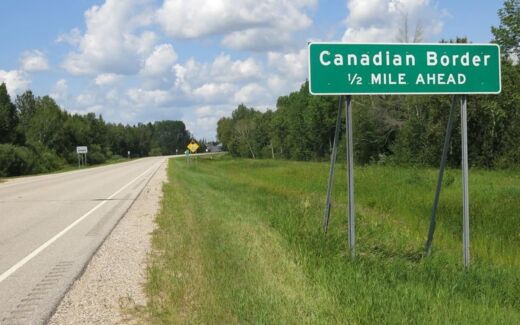
On February 15th, 2026, Canadian border officials intercepted an 87-kilogram cocaine shipment destined for Alberta, prompting emergency measures at the Coutts crossing. At first glance, the seizure appears significant. In context, it underscores a broader and more uncomfortable reality: the cross-border drug trade is not a one-way flow north to south.
Prairie Region director Janalee Bell-Boychuk emphasized the scale and persistence of the issue, stating, “This is a direct assault upon Prairie and Canadian communities’ safety.” Her remarks point to the ongoing efforts of organized crime networks to meet demand across the region. Yet even this sizable seizure represents only a fraction of the narcotics that move across borders undetected.
Estimates from the Canada Border Services Agency and Canada Revenue Agency suggest that the bulk of illicit goods, including drugs, firearms, precursor chemicals, and trafficked persons, flows from the United States into Canada, not the reverse. While illegal exports from Canada are valued at approximately $3.1 billion annually, imports from the U.S. are estimated to be four to five times higher.
This imbalance challenges the framing of Canada as a primary supplier. It also raises questions about how political narratives can obscure more complex cross-border dynamics.
Firsthand observations at border crossings reinforce these concerns. Reports describe individuals attempting to transport undeclared goods in increasingly sophisticated ways, from mislabeled chemical containers to concealed firearms in vehicle compartments. In some cases, individuals openly acknowledge the ease of moving items across the border, citing inadequate enforcement or inspection gaps.
The illicit tobacco trade has also expanded as prices rise, further incentivizing smuggling activity. These patterns reflect a broader economic reality: demand fuels supply. As financial pressures mount, participation in black-market economies becomes more attractive, particularly for those facing limited opportunities.
The human cost is significant. Gun violence linked to illegal firearms and drug trafficking continues to affect communities across Canada, with incidents occurring regularly in both urban and smaller centres. Contrary to common perception, some of the country’s highest homicide rates are found outside major metropolitan areas, often tied to drug networks and organized crime.

Young people are disproportionately impacted, both as victims and, at times, participants. Economic instability and unmet expectations can make the promises of illicit income difficult to resist. The result is a cycle of harm that extends beyond individual choices to systemic vulnerabilities.
Law enforcement agencies, including the Royal Canadian Mounted Police, report daily seizures of illegal goods, with larger operations occurring periodically. However, public messaging often emphasizes control and progress, even as underlying trends suggest persistent challenges.
This gap between perception and reality matters. When political leaders on either side of the border make sweeping claims, they risk misinforming the public and diverting attention from shared responsibilities.
A more accurate understanding of the drug trade requires acknowledging its transnational nature. Production, distribution, and consumption are interconnected across North America. Simplistic narratives, whether blaming Canada or the United States, fail to address the complexity of the issue.
If there is a path forward, it lies in cooperation rather than rhetoric. Better intelligence-sharing, coordinated enforcement, and public transparency would do more to protect communities than politically charged statements.
The question is not where blame lies, but whether both countries are willing to confront the full scope of the problem, together.
Stay in the loop with exclusive news, stories, and insights—delivered straight to your inbox. No fluff, just real content that matters. Sign up today!