



Editor’s Note: History doesn’t repeat, but it certainly rhymes. We are republishing this sharp analysis by Steven Kaszab from the TCN archives to give our readers the necessary historical baseline to understand this week’s current headlines.
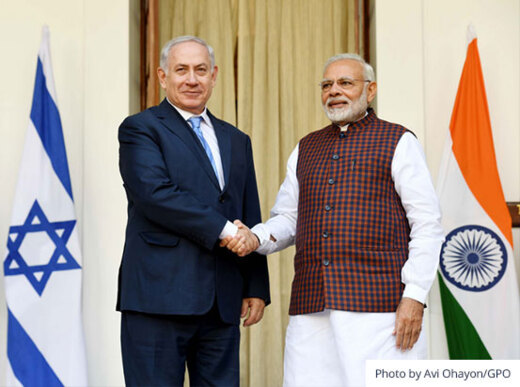
India and Israel appear to be testing the boundaries of a deeper strategic relationship. Political leaders from both nations recently engaged in discussions aimed at understanding each other’s political priorities and economic ambitions. The question now is whether this developing relationship will mature into a durable partnership or remain a pragmatic alliance of convenience.
These two leaders have just had a meeting of the minds. Behind that meeting lies a wider geopolitical calculation. India continues to emerge as one of Asia’s most influential economic and military powers. With a rapidly expanding economy, a vast population, and growing technological capability, India increasingly positions itself as a counterweight to China’s regional dominance.
Israel, for its part, has long pursued strategic relationships that strengthen its security, technological reach, and economic opportunities. The country is known for its: advanced defense technologies, cybersecurity innovation, and intelligence capabilities. These strengths make it an appealing partner for countries seeking both military cooperation and technological exchange.
A partnership between India and Israel therefore carries clear strategic logic. India gains access to advanced defense technologies, surveillance systems, and agricultural innovations developed in Israel. Israel gains a powerful economic partner with a vast market and growing global influence.
Yet, this emerging relationship unfolds within a complicated regional landscape. India’s relationship with China remains one of the defining tensions in Asia. The two countries share a long and disputed border, and their rivalry has intensified in recent years through military standoffs, economic competition, and competing regional ambitions. Both nations maintain large armed forces and expanding naval capabilities, reflecting their desire to secure influence across the Indo-Pacific region.
Economic competition adds another layer of complexity. China’s manufacturing dominance and global infrastructure investments have given it a strong foothold across Asia, Africa, and parts of Europe. India, meanwhile, seeks to position itself as an alternative hub for technology, manufacturing, and digital services. While both economies continue to grow, they are also navigating internal challenges including inequality, demographic pressures, and political tensions.

South Asia itself remains volatile. Relations among India, Pakistan, and Afghanistan continue to shift between uneasy diplomacy and open hostility. Long-standing territorial disputes and security concerns keep tensions high. Any conflict in the region carries the risk of broader escalation, particularly given the military capabilities involved.
One of the most sobering realities is that several countries in the region possess nuclear weapons. This reality imposes a fragile balance. Even minor confrontations carry the potential to spiral into larger crises if miscalculation occurs.
Meanwhile, questions about democratic governance and political power shape debates across the region. Some governments face criticism for consolidating authority or restricting political dissent. Others emphasize national security and stability in response to regional threats. These tensions between democratic norms and centralized power are part of a broader global conversation about governance in an era of geopolitical competition.
The role of the United States further complicates the picture. Washington maintains strong ties with both Israel and India and has encouraged greater cooperation among partners in the Indo-Pacific. American policy increasingly focuses on balancing China’s growing influence while strengthening alliances across Asia and the Middle East.
Against this backdrop, the India–Israel relationship represents more than a bilateral partnership. It signals the formation of new strategic networks linking technology, security, and economic development across regions.
Whether this partnership evolves into a lasting alliance will depend on several factors: regional stability, domestic political pressures, economic opportunity, and the shifting balance of global power.
What is clear is that geopolitical alignments are changing. Countries are reassessing old partnerships and building new ones based on shared interests rather than traditional blocs. In a world where power is increasingly distributed across multiple centers, relationships like the one forming between India and Israel may play a significant role in shaping the next phase of international politics.
Stay in the loop with exclusive news, stories, and insights—delivered straight to your inbox. No fluff, just real content that matters. Sign up today!